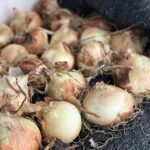
How to Guide: Plant, Grow and Harvest Onions
This guide will show you how to plant the onion sets and grow them. It will also go into detail all the way to harvesting them and storing for later use.
Materials
- Onion Sets
- Organic Compost
- Mesh Netting
- Hanging Mesh Bags
- Pruning Shears
Instructions
- Below is a detailed breakdown of each stage:1. Choosing the Right Variety • Onions are photoperiod-sensitive, meaning their bulb formation depends on day length. • Long-day varieties (e.g., Walla Walla, Red River) are best for northern regions where summer days are 14-16 hours long, ideal for areas like New Hampshire. • Short-day varieties (e.g., Vidalia, Texas Sweet) suit southern regions with 10-12 hours of daylight, perfect for warmer climates, like Florida. • Intermediate-day varieties (e.g., Yellow Candy, Super Star) work for regions with 12-14 hours of daylight, offering flexibility for mid-latitude gardeners. • Consider whether you prefer sweet onions (milder, shorter storage) or pungent ones (longer storage). For example, Texas Sweet is known for sweetness in southern latitudes, while Walla Walla is popular in the north.2. Starting Method: Sets or Seeds • Onions can be grown from sets (small bulbs) or seeds, with sets being easier for beginners due to higher success rates and quicker maturity (about 14 weeks). • Sets: Plant 1 to 2 inches deep, spacing 4 to 6 inches apart in rows 12 to 18 inches apart. Choose bulbs around ¾ inch in diameter to avoid bolting. • Seeds: More economical and offer more variety, but require starting indoors 8 to 12 weeks before the last frost. Sow seeds ¼ to ½ inch deep, initially spacing 1 to 2 inches apart, then thin to 3 to 4 inches. • For northern zones (e.g., Zone 5 and colder), sets are preferred, while seeds allow for greater variety selection.3. Soil Preparation and Planting Time • Onions need full sun (6-8 hours daily) and well-draining, loose soil to prevent rot. Mix in several inches of aged compost or manure in fall or early spring to enrich the soil. • Aim for a soil pH of 6.0 to 6.8. Ensure no rocks or compacted areas, as onions have shallow roots. • Plant in early spring, 2 to 4 weeks before the last frost, when soil temperature is at least 50°F (10°C), typically April or early May for northern zones. For fall planting, allow 4 to 6 weeks of warm temperatures before the ground freezes. In Florida, the onion sets get planted in early December. • Practice crop rotation to prevent diseases; avoid planting where other alliums (e.g., garlic) grew recently. Plant Marigolds to deter any pests. 4. Planting Details • For Sets: Bury sets with the pointy end up, 1 to 2 inches deep, spaced 4 to 6 inches apart, in rows 12 to 18 inches apart. Don’t plant deeper than 2 inches to avoid rot. • For Seeds: Use shallow trays with compost for indoor starting. Plant seeds ¼ to ½ inch deep, keep in a warm, well-lit spot (e.g., windowsill), and thin to 3 to 4 inches apart when transplanting outdoors. • For container gardening, use pots at least 10 inches deep, such as a 5-gallon bucket for 4 to 6 onions, with well-draining potting mix and compost.
- 5. Care and Maintenance • Treat onions as a leaf crop initially; foster foliage growth for larger bulbs. Cover immature bulbs with light mulch for protection, moisture retention, and weed suppression, but don’t cover emerging bulbs. • Water consistently, providing about 1 inch per week (including rain), more during hot spells to prevent bolting. Onions aren’t great at taking up water, so ensure the top inch of soil stays moist. • Fertilize every few weeks with nitrogen until bulbing starts, then stop to avoid excessive leaf growth. Use continuous-release plant food for best results. • Intercrop with marigolds, tomatoes or carrots to deter pests. Use mesh row covers for protection against onion maggots, especially in rainy periods.6. Harvesting and Storage • Harvest when the tops turn yellow and fall over, typically Fall/Winter planted onions, it will be mid-spring. Onions take a little over four months to grow here in Florida. I harvest mine in mid-April. For northern states, typically mid-summer for spring-planted onions. Get with your local agricultural extension office for more on your zone for growing times. • Loosen soil around bulbs with a fork, pull carefully, and cure in a warm, dry, airy place (e.g., garage) for 7 to 10 days. For southern states, hang to dry outside in the sun for 1-2 days. Cover the onions at night with netting to deter anything from getting the onions like a small animal. Once dry, bring into the garage for further curing. Ensure good air circulation during curing to prevent rot. I like to use a green netting. • After curing, trim tops to 1-2 inches and store in a cool (40-60°F), dry area with good ventilation. Make sure the onions are completely dry. Use mesh bags, boxes (no more than 2 layers), or braid for storage. Check regularly for rot or sprouting, and don’t store with apples or pears. • Sweet onions have high water content and shorter storage life; eat them first, while pungent onions last longer. For longer storage, dice the onions up and freeze for later use in dishes like spaghetti, taco meat, etc.