

Do you love supporting local farmers but can’t stand getting the eggs home and not being able to peel farm fresh eggs? I’ve been there. Now that we have chickens again, it feels like I am hard boiling eggs at least once a week.
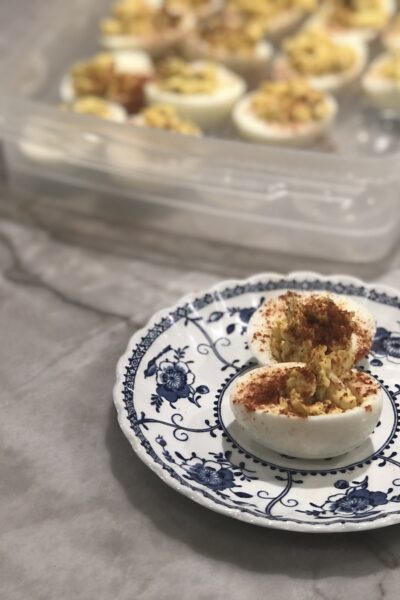
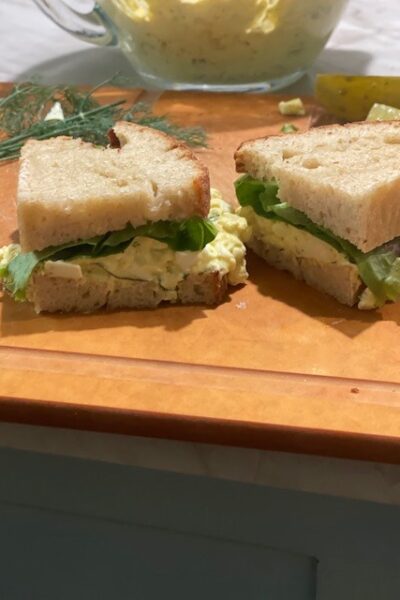
I love making Bacon Stuffed Deviled Eggs and Super Creamy Egg Salad with my farm fresh eggs. I used to struggle peeling them and I have finally figured out a tried and true way to get that egg shell off without damaging the egg.
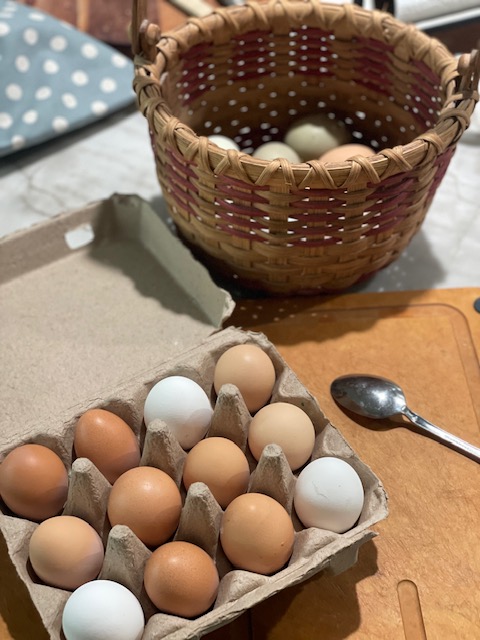
How To Peel Farm Fresh Eggs
I’m excited to share with you how I came up with a way to peel those hard shells from farm fresh eggs.
- Grab a spoon and an egg.
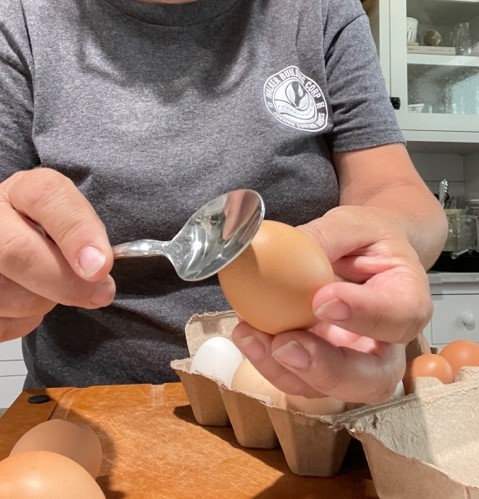
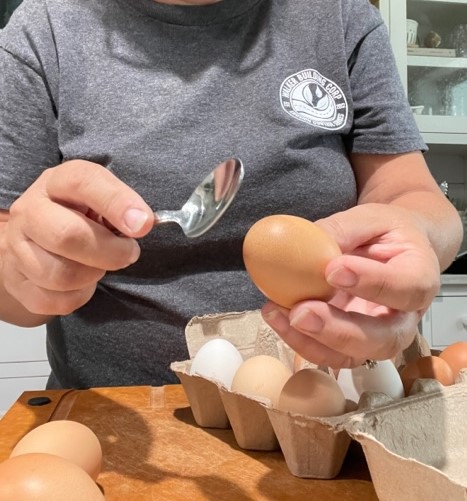
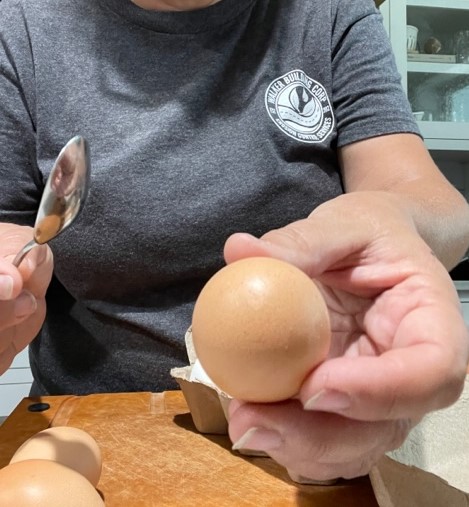
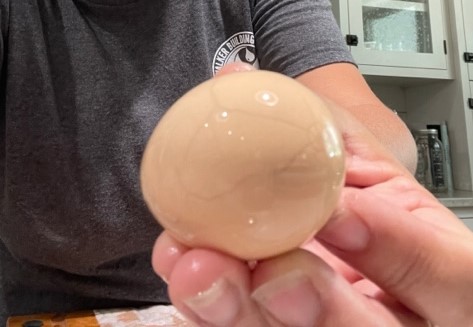
- Take the spoon and gently tap each end of the egg. The egg shouldn’t crack but produce a hairline crack. (See photo)
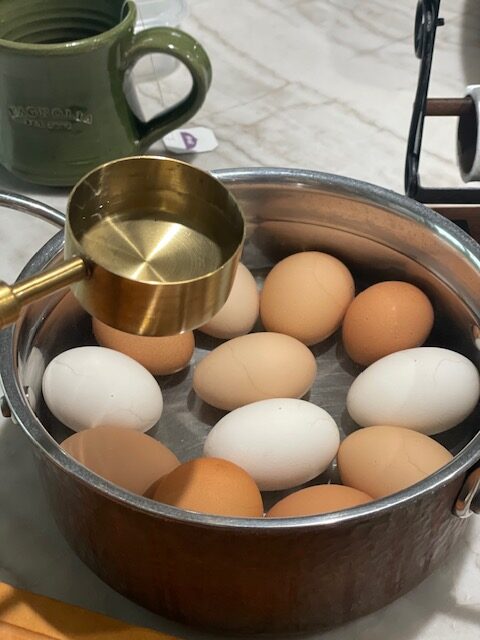
- Take your pot of water and turn the stove on high.
- Place your eggs in the pot and bring to a boil.
- Remove from heat and cover with lid. Set a timer for 13 minutes.
- Now, drain the water. Add ice cold water and 1/4 cup of white vinegar.
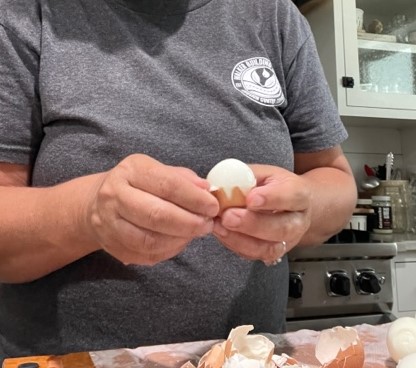
- Using a cutting board or paper towel, take one egg and tap gently on the surface. Start to peel the egg from the top of the egg, moving down to the bottom. The shell should just come off.
- Continue with the rest of the eggs and enjoy stress-free egg peeling.
Join Our Simple Living Community


Farm Fresh Eggs vs. Conventional Store Bought Eggs
Farm eggs and store-bought eggs differ in several key ways, based on production, processing, and quality factors. Here’s a concise breakdown:
1. Source and Production
Farm Eggs: Typically come from local farms or backyard flocks. Hens are often free-range or pasture-raised, with access to outdoor areas, natural diets (forage, insects, grains), and less crowded conditions. Smaller-scale operations mean more individualized care.
Store-Bought Eggs: Produced in large-scale commercial facilities, often with hens in cages or confined systems. Feed is standardized (grain-based, sometimes with additives), and conditions prioritize efficiency over hen welfare unless labeled otherwise (e.g., cage-free, organic).
2. Freshness
Farm Eggs: Usually fresher, often sold within days of being laid. They may not be refrigerated immediately, as unwashed eggs have a natural protective coating (bloom) that preserves freshness.
Store-Bought Eggs: Often weeks old by the time they reach shelves due to processing, grading, and distribution. They’re washed, removing the bloom, requiring refrigeration to maintain freshness.
3. Quality and Taste
Farm Eggs: Often have richer, more vibrant yolks (orange or deep yellow) due to diverse diets (e.g., greens, insects). Flavor can be more robust, though this varies by farm and hen diet. Shells may vary in color and size.
Store-Bought Eggs: Yolks are typically paler (yellow) due to uniform feed. Flavor is consistent but less distinctive. Eggs are graded for uniformity (size, shell quality), ensuring a standardized product.
4. Nutritional Differences
Farm Eggs: Studies suggest pasture-raised eggs may have higher levels of omega-3s, vitamin D, and vitamin E due to hens’ natural diets and sunlight exposure. Exact nutrition depends on feed and environment.
Store-Bought Eggs: Nutritionally consistent but may lack the enhanced nutrient profile of pasture-raised eggs unless labeled as enriched (e.g., “omega-3 fortified”). Processing can slightly reduce nutrient quality.
5. Cost
• Farm Eggs: Typically more expensive due to smaller-scale production, higher labor, and better hen conditions. Prices vary by region and farm (e.g., $5–$8/dozen).
• Store-Bought Eggs: Cheaper due to economies of scale, especially for conventional eggs (e.g., $2–$4/dozen). Specialty eggs (organic, free-range) cost more but are still often less than farm eggs.
Tools Used in This Recipe
I strive to only have products in my kitchen that contain no toxins, forever chemicals, lead or cadmium. Most of my items I’ve had a long time so I can’t find them anymore. From time to time, I will find a product that I truly trust and will recommend.
Pot with lid – I have their crockpot and electric skillet!
Spoon
Are Eggs Healthy?
Yes, eggs are generally healthy—nutrient-dense, affordable, and versatile. Here’s a breakdown of the health benefits and considerations:
Health Benefits of Eggs
- High-Quality Protein
- One egg = 6–7 grams of complete protein (contains all 9 essential amino acids).
- Rich in Vitamins & Minerals
- B vitamins (especially B12, riboflavin, folate)
- Vitamin D, vitamin A, vitamin E, and choline (important for brain health)
- Iron, selenium, phosphorus, and zinc
- Good for Eye Health
- Contain lutein and zeaxanthin, antioxidants that protect against macular degeneration.
- Support Brain & Nervous System
- Choline is key for memory and brain development, especially in pregnancy.
- Healthy Fats
- Mostly unsaturated fats (especially in pasture-raised or omega-3 enriched eggs)
Considerations
- Cholesterol:
- Eggs are high in cholesterol (~186 mg in the yolk), but for most people, dietary cholesterol doesn’t significantly impact blood cholesterol.
- If you have familial hypercholesterolemia or a known heart condition, talk to your doctor about egg intake.
- Cooking Method Matters:
- Healthiest: Boiled, poached, or scrambled
So, Are Eggs Healthy?
Yes—for most people, eating 1–2 eggs per day is safe and healthy, especially when part of a balanced diet with plenty of fruits, vegetables, and whole grains.
How To Peel Farm Fresh Eggs
Ingredients
Method
- Grab as many eggs as you need.
- Take one egg and the spoon. Gently tap each end of the egg. It shouldn't crack the shell but just place a hairline crack on the top and bottom of the egg.
- Continue with the rest. Now, fill a pot with water and the eggs.
- Over medium-low heat, bring water and eggs to a boil. Turn off heat.
- Cover with a lid and set the timer for 13 minutes.
- Now, drain the water. Add ice cold water and 1/4 cup of white vinegar to the pot.
- Next, using either a cutting board or a paper towel, take one egg and start rolling it onto the surface. The peel should just start coming off.
Troubleshooting
Make sure you are using ice cold water and white vinegar. They work together to make all that magic happen. If you get stuck on the top of the egg, take your spoon and tuck it up under the shell and gently start pushing it back and forth. The peel should come off with little damage to the egg.
Resources
Nagle, T. a. D., and P. C. Glatz. “Free Range Hens Use the Range More When the Outdoor Environment Is Enriched.” Asian-Australasian Journal of Animal Sciences, vol. 25, no. 4, Apr. 2012, p. 584.
Gonzalez-Mora, Andrés F., et al. “Assessing Environmental Control Strategies in Cage-Free Egg Production Systems: Effect on Spatial Occupancy and Natural Behaviors.” Animals : An Open Access Journal from MDPI, vol. 11, no. 1, Dec. 2020, p. 17.
Sergin, Selin, et al. “Fatty Acid and Antioxidant Profile of Eggs from Pasture-Raised Hens Fed a Corn- and Soy-Free Diet and Supplemented with Grass-Fed Beef Suet and Liver.” Foods, vol. 11, no. 21, Oct. 2022, p. 3404.
Pin For Later
I hope this has been helpful. I remember how frustrating it would be when I wanted to make deviled eggs and they looked horrible from the shells being so hard to remove. As always, tag me over on Instagram (@lhsimpleliving). I love seeing all the stuff you are doing. ~ Wendy

Wendy Lea Walker, NTP
Nutritional Therapy Practitioner



top part says to cover and lower the heat for the 13-minutes.
Directions say to turn off the heat and cover for 13-minutes.
which is it?
It’s the 2nd one, turn off the heat and cover for 13 minutes. I have corrected the post. Thank you so much for catching that!